Skimbleshanks
Old Possum's Book of Practical CatsSkimbleshanks is the Railway Cat whose presence makes the Night Mail’s departure and orderly passage possible. The poem first makes his importance felt through his absence: as the train prepares to leave, railway workers search for him, and the journey cannot begin until he appears. Once aboard, he supervises the Sleeping Car Express with a regular patrol, keeping watch over staff and passengers alike. His authority is both comic and practical: when Skimbleshanks is moving through the train, pranks and disorder have little room to flourish.
Identity and Introduction
The poem identifies Skimbleshanks by his railway role, calling him the Railway Cat and the Cat of the Railway Train. His name is also shortened to Skimble in the repeated calls made when he cannot be found. Rather than introducing him through family, home, or personal history, the account defines him through his work: he is the figure on whom the Night Mail’s departure and discipline depend.
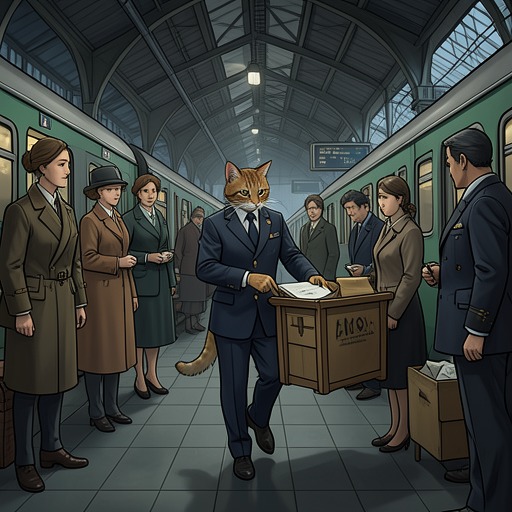
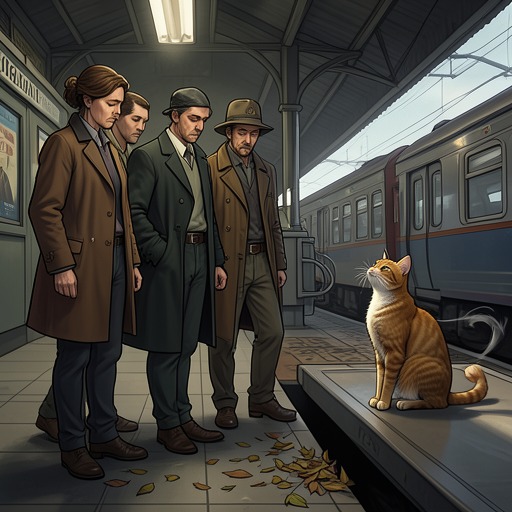
His introduction is staged at 11.39, when the Night Mail is ready to depart and a whisper runs down the line asking where he has gone. The possibility that he might be away hunting a thimble gives the search a playful, domestic image, sharply at odds with the railway’s urgent timetable. Guards, porters, and the stationmaster’s daughters join in asking for him; without Skimbleshanks, the train cannot start.
Authority and Patrol
The search continues as the signal draws near. At 11.42, the passengers are frantic, but Skimbleshanks appears and saunters to the rear. The contrast between the passengers’ agitation and his unhurried entrance establishes the manner of his authority: the railway’s urgency does not make him hurry, yet his arrival answers the crisis. The train then gets under way toward the Northern Hemisphere.
Aboard the Sleeping Car Express, Skimbleshanks is described as being in charge, more or less. His supervision ranges from the driver and guards to the bagmen playing cards. He paces the corridor and examines the faces of travellers in both First and Third, making the entire train his field of attention rather than restricting himself to one carriage or class of passenger. His regular patrol establishes control; the account links his movement through the train with the suppression of hilarity and riot. When he is about, people are quiet.
Night Work and Consequences
The poem makes Skimbleshanks’s authority consequential in plain terms: no pranks can be played with him, he cannot be ignored, and nothing goes wrong on the Northern Mail. The claim presents him not simply as a familiar presence but as a working safeguard for the journey. The earlier inability to start without him and the later assurance that the train runs without mishap frame his service at both ends: he is needed before departure and remains effective once the train is moving.
His work continues through the watches of the night, when he is always fresh and bright. Even during that watch he takes a cup of tea now and then, perhaps with a drop of Scotch, while keeping an eye on the train. The small refreshment belongs to the same routine as his patrol: a brief pause does not mean he has abandoned his responsibilities.
Narrative Role
Skimbleshanks is characterized through a sequence of railway duties rather than through private thoughts or a personal history. The timetable details, the approaching signal, the anxious passengers, and his measured return make his arrival the answer to a practical suspense: will the train be able to leave? His unhurried appearance resolves the delay, while his repeated patrol turns that moment of relief into an account of ongoing oversight.
The poem’s comic exaggeration gives a cat an expansive place within railway organization. Human workers search for him, passengers depend on his presence, and the order of the Night Mail is associated with his watchfulness. At the same time, the portrait remains grounded in specific duties: supervising railway staff, inspecting travellers in First and Third, discouraging disorder, and keeping watch through the night. Skimbleshanks’s distinction lies in joining these functions into one steady role, the feline authority on whom the train’s smooth running depends.